· Marisol Vance
How to Use a Ukulele Strap
Your strap is on the ukulele. That part takes two minutes, and most guides stop there. What changes your playing is what comes next: where you set the length, what you check before you stand, and what your fretting hand does with the job you just took from it.
Attaching the strap in the first place — buttons, soundhole hooks, headstock loops — is covered step by step in how to put a strap on a ukulele. This guide starts one step later, with the strap fitted and the ukulele hanging in front of you.
How to use a ukulele strap: start by letting go
Stand up, put the strap over your shoulder, and take both hands off the ukulele.
That is the whole test, and almost nobody performs it. If the instrument stays put and the neck sits a little above horizontal, the strap is carrying the ukulele. If the neck drops toward the floor, or the body creeps around your ribs as you breathe, the setting is wrong and your hands will spend the next hour compensating for it.
Expect the first attempt to feel odd. A player who has held a ukulele bare-handed for months keeps gripping for about a week: the fretting hand has learned that letting go means dropping it. Repeating this test each session unlearns that.
Set the length once — and do it standing
Set the length standing, even if you only ever play sitting down. Seated, the chair and your forearm quietly help hold the instrument, so a length that is far too long still feels acceptable. Standing removes those helpers. A strap set standing works seated; one set seated is almost always too long the moment you get up.
Step 1. Put the band over the shoulder on your fretting side — the left shoulder for a right-handed player — and check it lies flat for its whole length rather than twisting at the shoulder.
Step 2. Stand normally, arms by your sides, and look down at where the ukulele has settled.
Step 3. Move the slider until the lower edge of the body sits at the bottom of your ribcage, soundhole roughly level with the base of your sternum. On most adults that is higher than instinct suggests.
Step 4. Sit back down without touching the strap. The neck angle should barely change. If the ukulele lands in your lap, it is still too long.
Step 5. Leave it alone. The point of a slider is that you set it once and stop thinking about it.
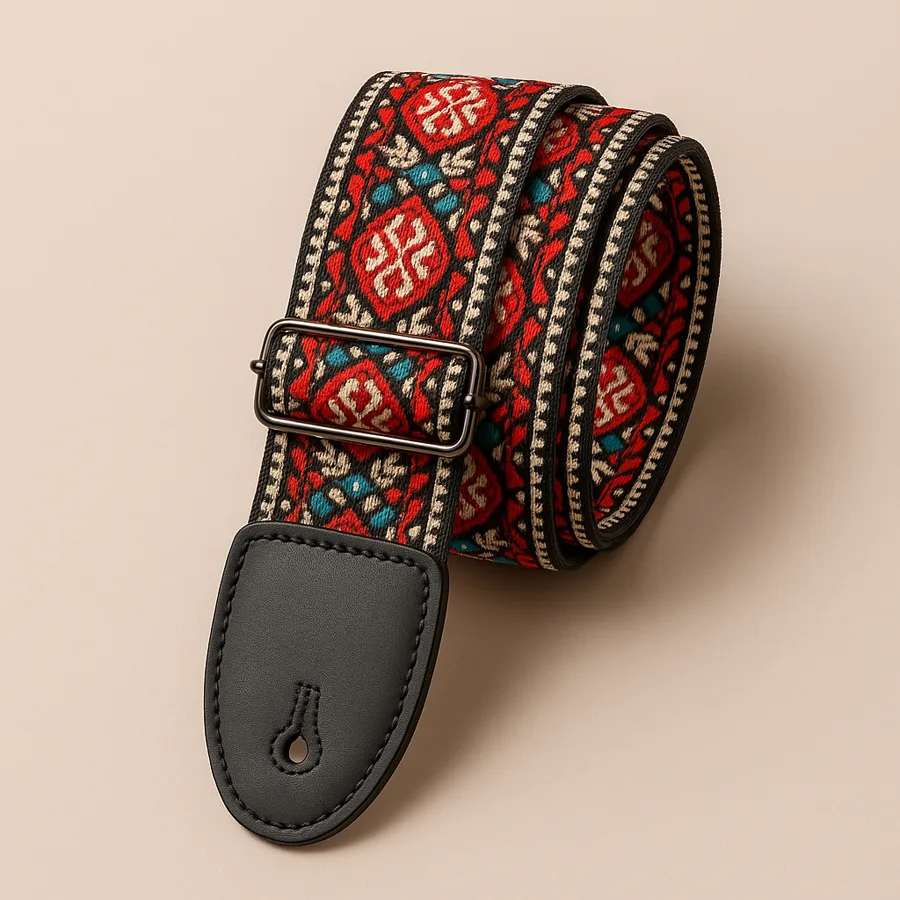
Why height decides whether the neck stays up
Guitar players argue about strap height as a question of style. On a ukulele it is a question of leverage. The neck is short and the headstock is heavy relative to the body, particularly with geared tuners rather than friction pegs. Hang the instrument low and that headstock has a long lever to pull down with: the neck drifts toward the floor, and the fretting hand ends up holding it back up — precisely the job the strap was meant to remove.
Worn high, the same weight sits close to your centre and the neck rises on its own. A second effect matters more for chord work: the higher the body sits, the closer the fretboard is to your fretting shoulder, and the less the wrist has to bend outward to bring the fingers over the strings.
The useful range is narrow. Between the soundhole level with your sternum and level with your navel, everything about the fretting hand changes — try both in one session and you will hear it within four chords. Where the body rests against you is covered in how to hold a ukulele.
What using a ukulele strap hands back to your fretting hand
Without a strap your fretting hand holds two jobs: it shapes chords, and it stops a smooth, round-backed instrument sliding down and rotating away. The second job is constant and invisible, and it is why beginner chord changes feel stiff long after the shapes are learned. Take it away and three things open up.
You can lift the whole hand off. Most players never fully release between chords — they drag the fingers along the strings toward the next shape, because lifting means losing contact with an instrument they are also holding in place. That drag is what produces the scrape and the buzzed first beat on a change.
Your thumb can move. Open chords want the thumb behind the neck; a barre wants it lower and flatter; a stretch up the fretboard wants it further back again. A thumb that doubles as a clamp stays where it is, and every shape has to be built around it.
You can travel up the neck. Moving to the fifth or seventh fret means the hand leaves the position that was steadying the ukulele. Unstrapped, that is the moment the body rotates away and most players abandon the idea. Strapped, the neck stays where you left it.
A fourth change is quieter: pressure. Most beginners press about twice as hard as a nylon string needs, and much of that force is grip rather than fretting. A hand relieved of holding duty presses less almost straight away.
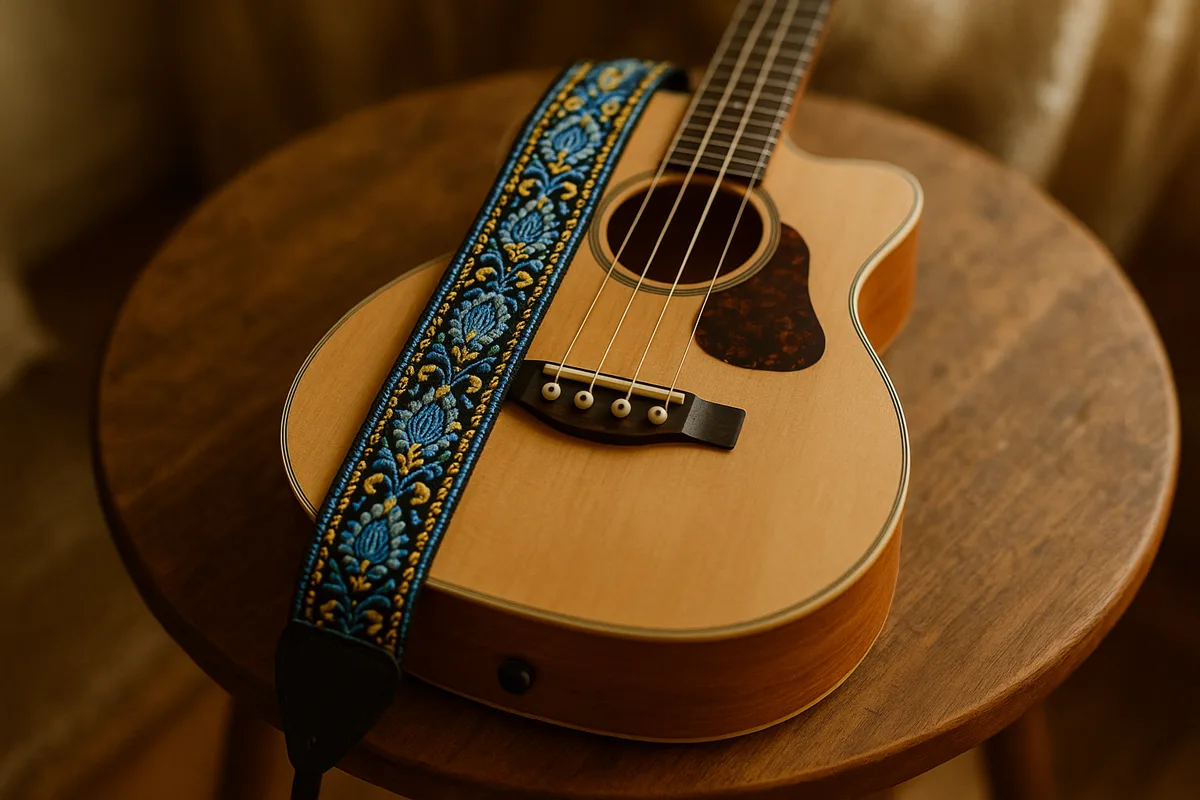
The wrist angle you can finally straighten
A bent fretting wrist is rarely a wrist problem. It is a position problem: the instrument sits too flat or too far away, and the hand reaches around the neck to make up the difference.
A strap works on the cause. Because the body is held against you, you can tilt the ukulele — face angled slightly up toward you, neck up and out — without the fretting hand paying for that tilt in grip. The tilt puts the fretboard where your fingers already point, so the wrist stays closer to straight.
The reach dividend is immediate. A straighter wrist gives every finger more travel: the ring finger reaches the third fret on a D shape without dragging the other two out of position, and a barre across the third fret stops needing a squeeze. If a chord has been sitting on your "cannot do it yet" list, raise the strap and try it again.
Using a ukulele strap: four checks before you stand up
Standing is where a setup that felt fine in a chair finds you out. Run these four before you leave the seat, and again after the first song.
1. Seat the keyhole. Push the leather end fully onto the button so the wide part of the slot clears the head, then let it settle back so the narrow neck holds it. Buttons are covered in the strap button guide.
2. Snug the top anchor. A headstock loop belongs behind the nut, tight enough that it cannot ride up over the tuners. On a soundhole hook or a tie, the same check applies at the anchor — the no-drill guide explains what each rests against.
3. Press the sliders back. Woven bands creep with movement. Push the band back through the slider until it sits firm rather than assuming it stayed put.
4. Hands off, then move. Stand still first, then take a step and turn. Anything that is going to shift will shift on the turn, not while you stand still.
Fitting a child, and re-fitting as they grow
Fit the strap on the child, never on an estimate. Stand them up holding the ukulele, put the band over their fretting shoulder, and shorten it until the body of the soprano sits at their chest and the neck lifts.
A child's setting is proportionally higher than an adult's. Their strumming arm is short, so the body has to come up to meet the arm rather than the other way round, and a height that looks comically high to a parent is usually the correct one.
Leftover band at the short end is normal and does not need cutting. Fold the spare back against the band and thread the tail through the slider so it lies flat behind the shoulder — cutting removes the range you will want back within a year.
Re-check each term. A child who has grown is playing on a strap that is now long, and the first symptom is never a complaint: it is the fretting hand quietly starting to grip again. A strap that arrives as a December present will want one adjustment by spring, and it takes five seconds.
Adjustable range, enough for one setting to suit a child on a soprano and another a standing adult
— Fretweave product specification, 2026
Band width, which spreads the instrument's weight across the shoulder instead of a thin line
— Fretweave product specification, 2026
Growth in U.S. fretted-instrument participation over the last decade, led by ukulele and guitar
— NAMM Global Report, 2023
Habits that quietly undo the setting
Wearing it long for the look. Worn very low, the pattern disappears behind the body and the neck dives at the same time; worn at chest height, the band crosses the torso where it is seen. The playing setting and the good-looking setting turn out to be the same one — the vintage and boho style guide goes further into that.
Correcting with your shoulder instead of the slider. If the ukulele has drifted low over an hour, the slider crept. Move the slider back; hitching your shoulder up puts the tension somewhere it does not belong.
Taking it off between songs. The hold you rebuild each time is the gripping one. Leave the strap on for the whole session and let the new habit settle.
Gripping out of habit. For the first week the fretting hand keeps clamping, because it does not yet trust that something else is holding the instrument. Consciously open the hand between chords for a few days and it stops on its own.
Frequently asked questions
How high should a ukulele strap be?
High enough that the soundhole sits roughly level with the base of your sternum and the neck angles up rather than down. Set the length standing, then sit and check the neck angle barely moves. Worn lower, the headstock starts pulling the neck toward the floor and the fretting hand ends up holding it back up.
What does a strap change for seated practice?
It takes the instrument off your lap and off your fretting hand. Seated players notice it in chord changes first, because the hand can lift off the neck completely and land on the next shape instead of sliding into it. The height setting is the same one you use standing.
How do you adjust a ukulele strap for a child?
Fit it on the child rather than estimating. Band over their fretting shoulder, then shorten it until the body of the ukulele sits at chest height and the neck lifts. Keep the spare band folded and threaded back through the slider rather than cutting it, and re-check the length every few months.
All of this depends on a band that holds the setting you gave it. Our embroidered ukulele strap runs two sliders and PU (faux) leather keyhole ends, so the length you set is the length you find next session — and the same band moves onto a guitar or a bass.

Marisol Vance · Ukulele teacher and strap collector, 9 yrs
Marisol has taught ukulele for nine years and set strap heights for hundreds of students, from six-year-olds on sopranos to adults playing standing for the first time.